
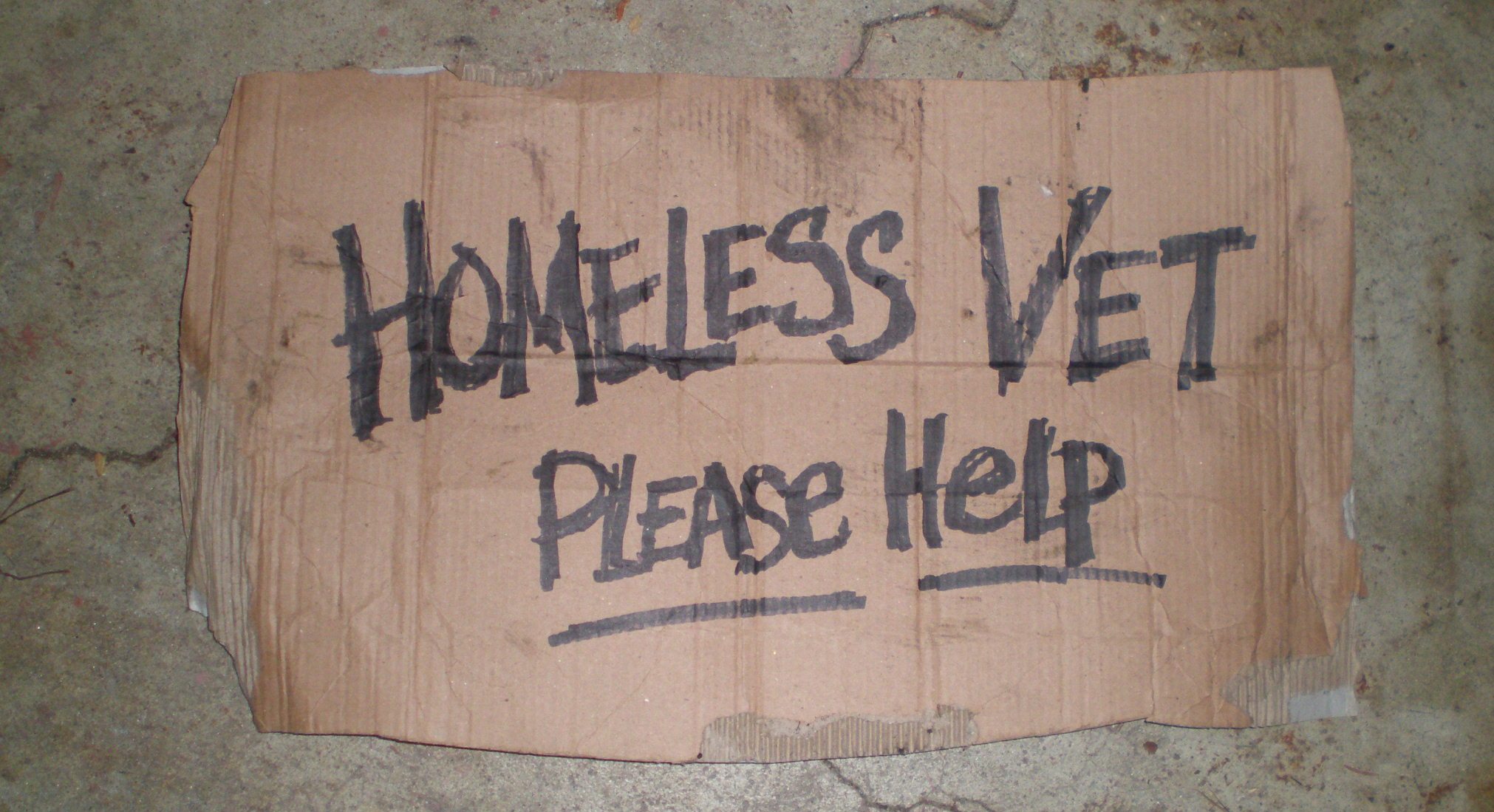
 “HOMELESS VET – please help” The rough letters were drawn with magic marker on a brown piece of beat-up box flap. His expression was sagging grief, a scowl melted by the pounding sun into a slackness flowing down over his shoulders, softening the spine into a posture of surrender. Filthy and tattered, it was hard to decide his legitimacy. He clearly needed help. I supposed adding “Vet” was to evoke a sense of responsibility and guilty sympathy, as though we owed him for his condition. Who can say? Perhaps we as a society do owe every human the basic resources necessary for the success of humans as a species.
But what does it mean to be homeless? Does it refer to a structure or a state of mind? Clearly, shelter is the primary aspect, but there’s more to it I suspect.
Having a home has always been especially important to me. It represents a life security that is more than just shelter from the elements, or protection for me and the things I’ve acquired over the course of my life. It has more to do with continuity, I think. Having an environment that is under my control and is therefore predictable and dependable. That, of course, includes elements such as security for me and the things I value, but encompasses other issues that relate to my sense of self.
Then what qualifies as a home? Does it have to involve a roof and walls? Are there specific, minimum dimensional requirements or, again, is it about a state of mind? Is there a time limit to the definition? Suppose I am stranded in an unfamiliar place for a time with no lodgings. Does that consititute homelessness? Does temporary housing count? What if I don’t have a permanent dwelling and have taken up temporary residence in a hotel? Am I then technically homeless? How long is temporary?
Maybe George Carlin had a good point and it’s about “stuff”. Where do you keep all of your stuff?
Homelessness is a real, unavoidable issue in cities worldwide. As populations continue to grow, the demand for space sends the cost for shelter higher, increasingly beyond the reach of those having fewer resources. When the baseline for primary needs exceeds the minimum wage capacity, alternatives must be sought. Roommates, living with family, second incomes, and “trading down” to cheaper dwellings are some of the ways people manage to maintain their hold on that basic human need.
But some people, many people, just can’t manage to meet the demands required and find themselves without roof.
Some of the ones that you see on the street who are begging I think are more about hopelessness, really. Once you don’t have an address or a shower, who’s going to hire you? Of course it can be done but it takes motivation and determination.
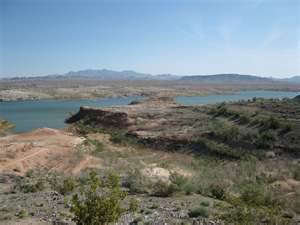 A friend of mine in Las Vegas recently found himself without a place and without the advance money necessary to get a new one. He had a steady, though low-paying job working “graveyard” in a hospital, but was in debt to the degree that there was never any surplus cash for such frivolities as first and last month’s rent, security deposit and hookup for the utilities. He decided to go ahead and be homeless for awhile but keep the job somehow. A Post Office box handled the mail, a cell phone got him his work assignment calls, and he could pick up his check at work. He started by camping out at Lake Mead, hiding his tent under some tamarisk trees to minimize scrutiny while he was gone to work. Fortunately there tends to be a population of regulars who look out for each other there in that isolated desert oasis.
This arrangement worked fine until summer kicked in (right around when everyone else is enjoying spring) and he found the tent unbearably hot for a day sleeper. So he pulled up stakes (Literally,…yes, that’s where the expression comes from) and moved to the cooler mountains near a spring. It greatly increased his drive time (and gas investment) but nevertheless it served him while he got back on his feet.
I’ve found myself in various states of homelessness in my life, prompting these musings.
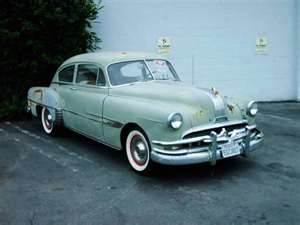 My earliest experience with homelessness was when I was five years old. My folks loaded up the old, pale green Pontiac (ironic, since that was the town in Michigan where I was born and that we were leaving) and moved my younger brother Dhan and me to California. Mom was seriously pregnant and in danger of miscarriage and had heard that there was a new procedure there that might save her unborn child. She had already lost two babies to a then not fully understood rh blood factor incompatibility that had left Dhan with Cerebral Palsy and mild retardation. There were also better programs for him there and the climate was supposed to better for my asthma. With very little cash and no specific plan in mind, we set out in the summer of 1957 for Southern California via the now famous Route 66.
 I remember the floor of the back seat was filled up to the seat level, creating a nice platform living area for two car-bound 4 & 5 year-olds. The highway was smaller then, but popular, and was littered with townlets offering amusing motels, roadside attractions, and eateries. Because of our limited funds, Mom mostly made sandwiches and we slept in the car. They took turns driving, alternately sleeping, so we rarely got to stop overnight anywhere, though we did stop briefly at a number of National Parks such as the Painted Desert, the Petrified Forest, and the Grand Canyon.
 The farther west we went, of course, the climate became hotter and drier so more stops got us cold drinks and ice, cool “western” kiddie sunglasses with little six-guns on the colorful, flexible, plastic frames that hooked behind the ear, and hanging off the
 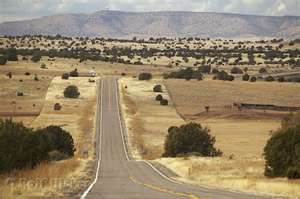 hood ornament shaped like Chief Pontiac himself was a canvas radiator bag filled with water that slowly seeped, cooling the engine as we drove and drove toward the sunset.
We arrived in LA broke and Dad was unemployed. As I think of it now, it must have been really hard to hunt for work when your family was living in the car. I don’t think it was long before they found us a place at the Michigan Trailer Park in Baldwin Park, about twenty miles east of downtown Los Angeles. They were attracted to the place because of the name, seeing it as an omen, but stayed because of Tex and Monty.
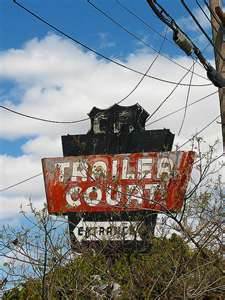 They were the proprietors of the tiny trailer park abutting the freeway. The sweet old couple had moved there from Michigan after WWII and bought the run-down property wedged between the San Bernardino Freeway and what was then Rivergrade Highway, a road that went north following the San Gabriel River course upstream, a seasonal wash more than an actual waterway most of the year, meandering its way down from the mountains, depositing deep drifts of gravel as the land leveled out. The highway was always busy with big semi trucks hauling dusty loads of gravel from the many deep, gaping quarry pits
Tex Mullins and his wife, Montana Rose were a kind and hospitable couple who recognized our need, insisting that we stay there and not worry about the rent or deposits until Dad could find work.
 There were a dozen or so weathered, old trailers lined up along the walls running back into the lot with a driveway that ran up the center past the office and between Tex and Monty’s house and the duplex on the west. A few large eucalyptus trees along the west wall offered some shade and Monty’s year-round flower garden and blossoming orange tree brought color and a reminder that we no longer lived in the land of the shivering gray darkness of winter.
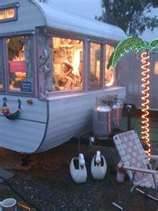 We gratefully moved into a cozy old vacation trailer that offered electricity, a dining nook that converted into a bed that Dhan and I shared, and a kitchen area with a little refrigerator and stove and a sink with running water. There was a separate bedroom at the back about as big as the double bed in it, partitioned by an accordion door. The toilets and showers were in a bathhouse situated near the middle of the park, next to Tex and Monty’s house. They were clean and had a distinctive standing water and soap smell to them that I vividly remember; not unpleasant, but definitely a public bathhouse. Not having a toilet in the trailer was the hardest part for a kid too young to make the trip up the drive to the bathhouse in the middle of the night. You just had to hold it until morning. (bedwetting was frequent)
Every day, Dad would drive off in search of work and Mom, Dhanny and I would set off looking for discarded pop and beer bottles. In those days you could get 2 cents deposit back for a regular size bottle and a whole nickel for a quart-sized jumbo! Dad took a scavenged coke crate and nailed some broken skates to the bottom,…you know, the kind with metal wheels that clamped onto the bottom of your shoes with a skate key. A jump rope for a pull handle completed our bottle collection wagon.
While Dad was out searching for machinist work, we’d walk up and down Rivergrade Highway (eventually the 605 freeway) hunting for bottles, dragging the unsteady cart behind us, clinking and clattering on the blacktop.
Dhan was in full body braces then, legs and back, to help correct for the athetoid Cerebral Palsy. He was only four at the time, but managed to stump around in them pretty well, despite the weight.
Picture it: Mom massively pregnant, Dhan plodding around in those medieval-looking heavy metal leg braces, and me bone-skinny, hunched over fom the wheezing, dragging this noisy cart up and down the dusty, busy highway gathering beer and pop bottles that the truckers tossed out, throwing up clouds of grit as they rumbled by.
When Dad got home, we would then take them in the car to the big “Crawford’s Country Store” in El Monte where we could cash them in for the deposit. We made a game of putting on our “bottle eyes” to spot even more bottles on the way as we drove. “Jumbo! I see a Jumbo!” The store was a big, “country market” discount place that also sold things in bulk. We’d get these big tubs of peanut butter and margarine and milk and such. Then we’d go to the Weber’s day-old bakery outlet for our bread. Peanut butter and “butter” sandwiches were a regular at mealtimes. (To this day I have issues with peanut butter, but, do you know what? I never went to bed hungry.) There was a Thrifty Drug Store on the way back that we would stop at if we’d had a successful collecting day, and we’d get their famous nickel scoops of ice cream before heading home.
Home.
See, that’s how I remember it. Home, then, in this case, was where my family was…the people I loved, whether it was in the back seat of the old Pontiac, or the funky trailer park.
Dad eventually got work in another town and we moved into a “real” house in a nice neighborhood with good schools and our lives returned to the “middle class”.
_________________________________________________________________
Many years later, Dad retired and the whole family moved to Las Vegas. Though Mom and Dad had been divorced for many years, they had invested together in a house toward their retirement. I had been on my own for some time by then, though Dhan was still living at home at Mom’s with his wife (also developmentally disabled after birth from brain damage) and newborn baby daughter, Beth Kellie, a healthy, normal child whom Mom was raising for reasons apparent. When Dad announced that he was retiring and selling the house and that Las Vegas was his  destination, Mom reasoned that she might fare better in the more affordable city which would also be near Dad to share the grandparenting. Dad got a tiny motel conversion condo near the airport, to be near “The Strip” and she took her share of the house sale and bought a couple of cute but dilapidated condos in nearby Henderson. Dhan and Ann lived in one and she and Beth lived in the other.
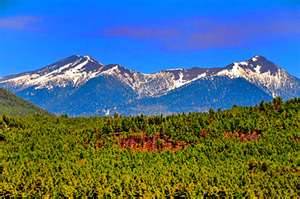 I took the opportunity to move to Flagstaff, Arizona. I had been living the urban life for most of my life and wanted to try something different. Work was scarce for me, though, and after about a year of
  underemployment and a more severe winter than I was prepared for, I disappointedly decided that, as much as I loved the fresh mountain living, it was time to go back to a city.
I had never even considered Las Vegas as an option. It was too hot, too tawdry, and too culturally transient to my way of thinking. Besides, I’d always carried a lot of responsibility with my family and was reluctant to “re-enlist”. I could go back to LA but had had my fill of it and was ready for something new.
Part of my indecision tied to my family. My Mom’s health wasn’t good and the strain of raising a newborn baby virtually alone was taking its toll. Dad had gambled away all of his retirement money by this time and was struggling to save the last investment he had made in a pizza restaurant. The people he had partnered with who were running the store were struggling to make a go of it and eventually left rather abruptly to go get paying jobs, leaving Dad to run the shop alone.
 Personally feeling a sense of failure of achieving my rural dreams, I gave up my place and put all of my things in storage in Flagstaff and relocated to Henderson temporarily. Dad’s place was impossibly small and Mom’s was way too crowded so I decided to stay out at the Lake while I thought about the situation, camping in the back of my Toyota pickup with my dog, Sheila. We’d go into town every couple of days to visit, check my phone messages, shop and shower.
Dad had a couple of employees by then but still needed help so, taking care not to intrude on egos, I did what I could now and then to help organize things there, setting up an office area for him, even working occasionally in the kitchen and delivering a couple of pizzas.
Another priority was giving his head cook some tips in hygeine. Bob was a homeless Vietnam vet whom Dad had worked out a deal with, since, for some reason, he was the only one left from the original team who knew the recipies on the menu. A nice guy, but seriously lacking in self esteem and social refinement. He got to stay in the back room, got some stipend, and all the pizza he could eat.
Late autumn gave way to early winter, but I was still busy enough with adapting to the transition that the concept of my own homelessness hadn’t sunk in. The weather was nice and it still just seemed like an extended camping trip.
__________________________________________________________________
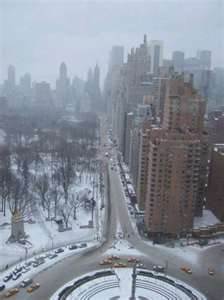 I was still working for Mattel occasionally, doing freelance projects that could last anywhere from a few days to weeks. Every year in February they had their Toy Fair in New York City and I was part of their decorator crew who installed the displays. The job always started out with creative enthusiasm but quickly deteriorated into a grueling death march that lasted for three or four weeks with escalating hours and no days off. This was their biggest show of the year so the stakes and tensions were high. Monumental work loads were always overtopped when the marketing staff and upper management started arriving late in the game and began making sweeping, usually capricious, last minute changes that plunged us into the abyss of all-nighters.
The more fatigued I got, the less tolerant I became. New York City has never suited me. Way too urban for my comfort range. When you consider that I had gone from the spectacular pine tree forest at the base of the snow-capped San Francisco peaks of Northern Arizona and then to living naked in the hot, dusty Nevada desert, to hitting the ground running in midtown Manhattan in the dead of winter, my disorientation was understandable.
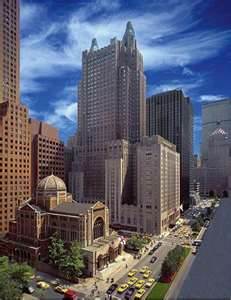 One of the consolations of the job was that they usually put you up in very nice hotels, to cushion the impact I suppose, and this time it was the Waldorf Astoria. Sadly, as the project progressed, you saw less and less of that precious refuge.
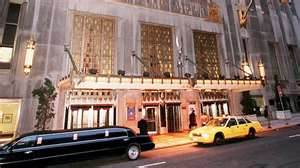 I had been out in the frozen February Manhattan wilderness all day long, shopping, and got back to the hotel late feeling cold, tired, lonely, and depressed. Rather than sink into a funk, I decided to sink into a hot bath. I snagged a shamefully overpriced Bailey’s from the mini-bar and poured some essential oils into the tumbling water, and eased myself into the restorative soak.
As I lay there mulling over my predicament I started to feel sorry for myself. All of my things were in storage in Flagstaff and I was living in my truck and having to pick up my mail from my Mom’s. My career with Mattel had always been freelance which meant that each project had the potential to be my last, which added to the tenuousness of my situation. Moping about my homelessness, I reached for the snifter of liqueur, …when suddenly I was struck by the absurdity of the moment. Here I was lamenting my homelessness while I lounged in my marble bathtub at the Waldorf Astoria, sipping imported cocktails from my private bar!
I decided then and there that wherever I was at any given time must be where I live.
_____________________________________________________________
It’s a good thing, too, because now I find myself in an entirely different “homeless” situation.
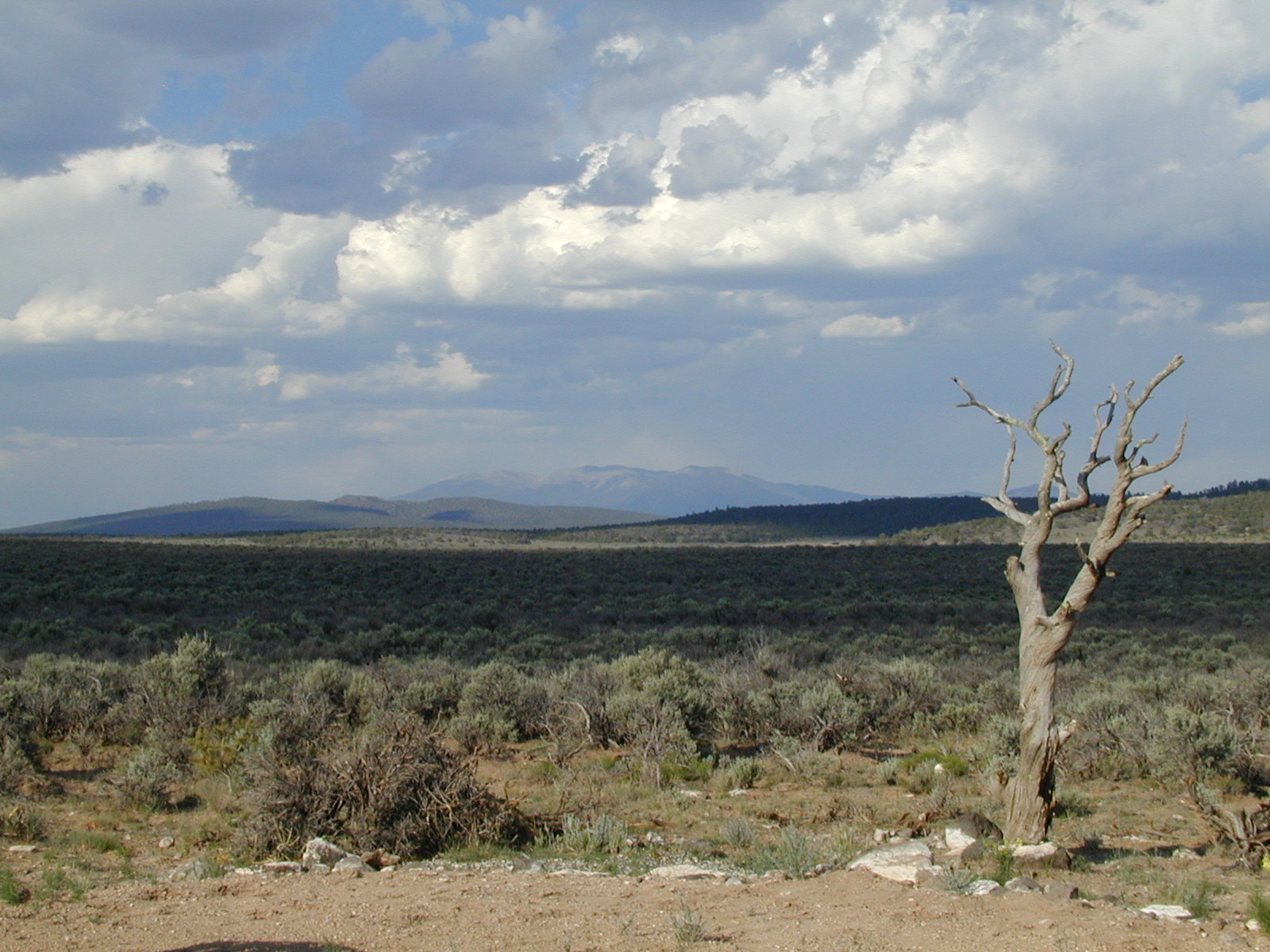 After Mom and Dad died, and Dhan and Beth went to live with relatives in Michigan, I sold Mom’s house, put everything into storage, and bought 17 acres of pristine sagebrush outside of Taos, New Mexico. I had always dreamed of a homestead and decided it would be a good retirement plan to have an off-grid, self-sufficient, paid-for home.
The plan was to build a modest straw bale house to start with and then I’d have a life project to keep me busy through my “golden” years. Straw bale construction is a locally popular, time-tested method of creating well-insulated, affordable structures which are then stuccoed, giving them the appearance of the local adobe style.
Most of the money went to the purchase of the land and the necessary systems, such as solar panels, a water tank, and a composting toilet, leaving a dwindling stake for building materials. To complicate matters, the drought in the region had left less local straw available and driven up the prices. I managed to source a place about three hours drive away in Colorado, but had to pay a premium to have it trucked down to my land. I decided to start with a hundred bales, figuring eventually I’d probably need about a total of three hundred.
I hired Joe, a local guy with a backhoe, to carve a dirt road down to the site and trench out for the foundation footings. Then this other guy, Chuck, a fellow off-gridder ( who’d had the good sense to sink his stake into a beat up old Winnebago, instantly providing him with both transportation and lodging on his land) hitched up a big trailer and brought me my first hundred bales.
What a hot, sweaty endeavor hefting and stacking bales in the hot summer sun can be! My buddy Ken from Seattle and Chuck and I, new to the bale thing, eventually discovered that we could just roll them off the back of the trailer, … and that sometimes they bounce when they land. (unless they break apart, of course) Re-stacking them was something else but at the end, we had a tall, clear plastic-clad straw cube sitting on the land, a gleaming monolithic sentinel in the sagebrush.
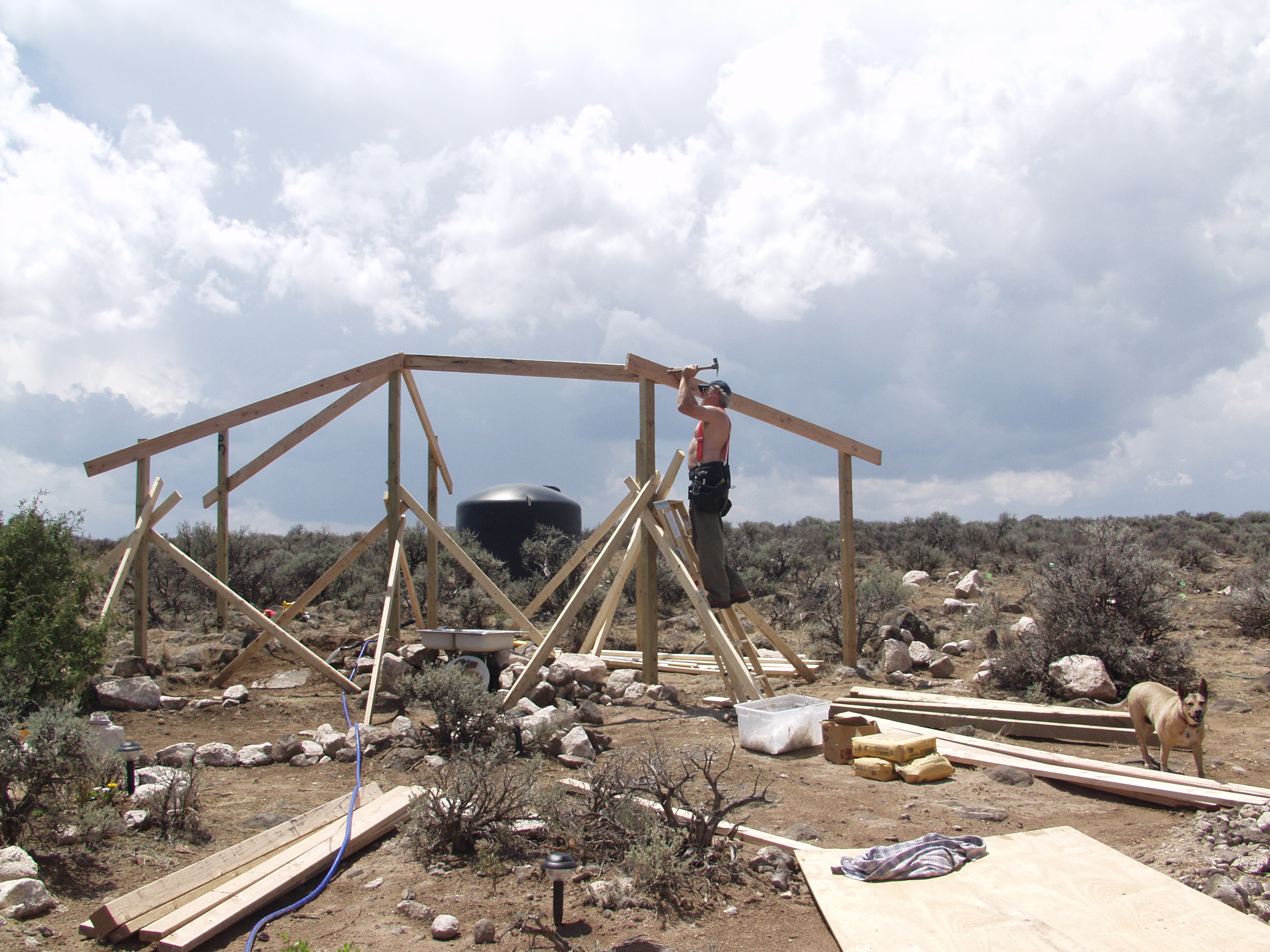
 Ken and I had begun building a temporary, open-air bathhouse which had grown to include a space for a toilet and a sheltered kitchen/eating space. The persistent wind and abundant sun required some kind of shelter.
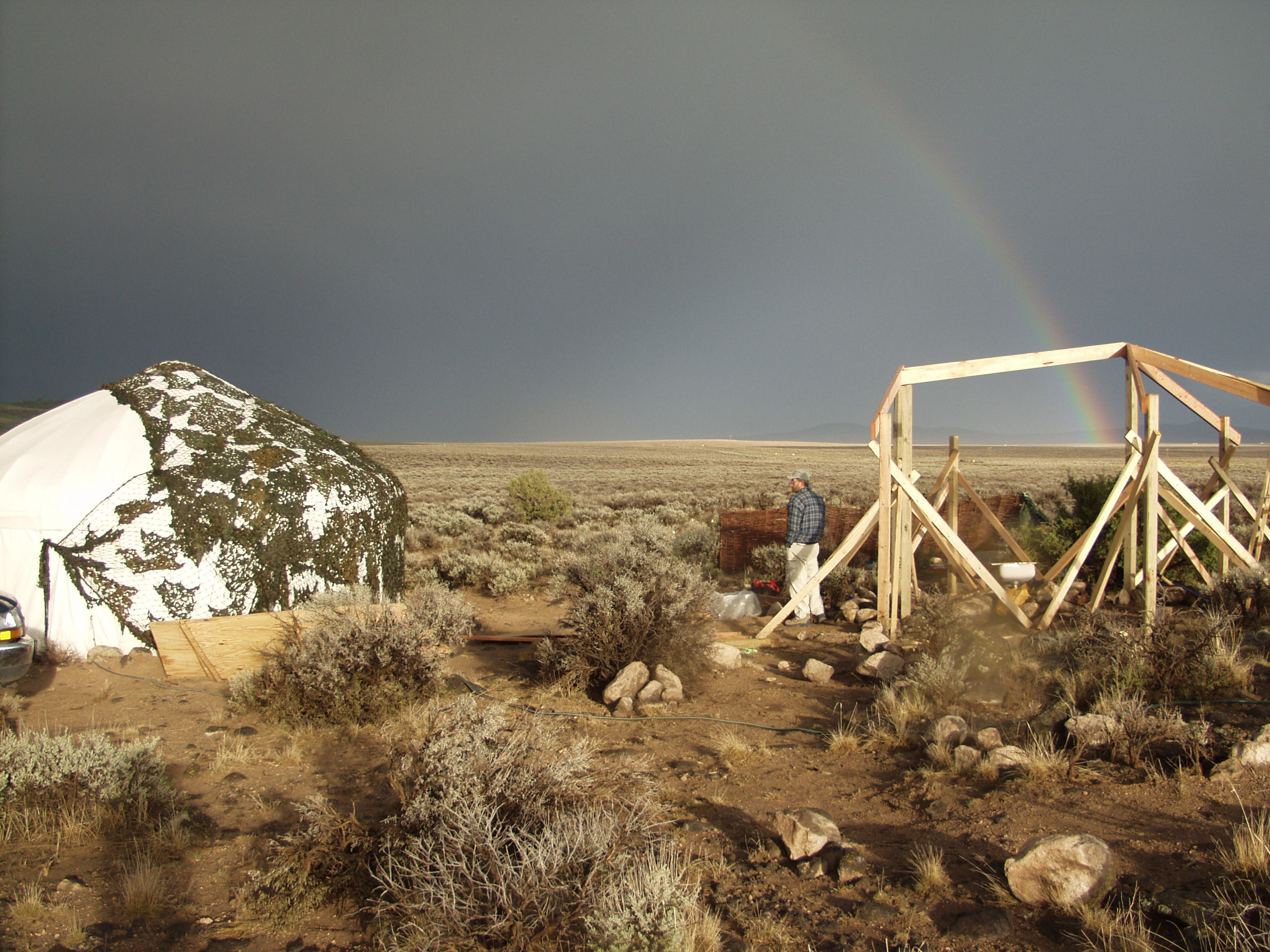
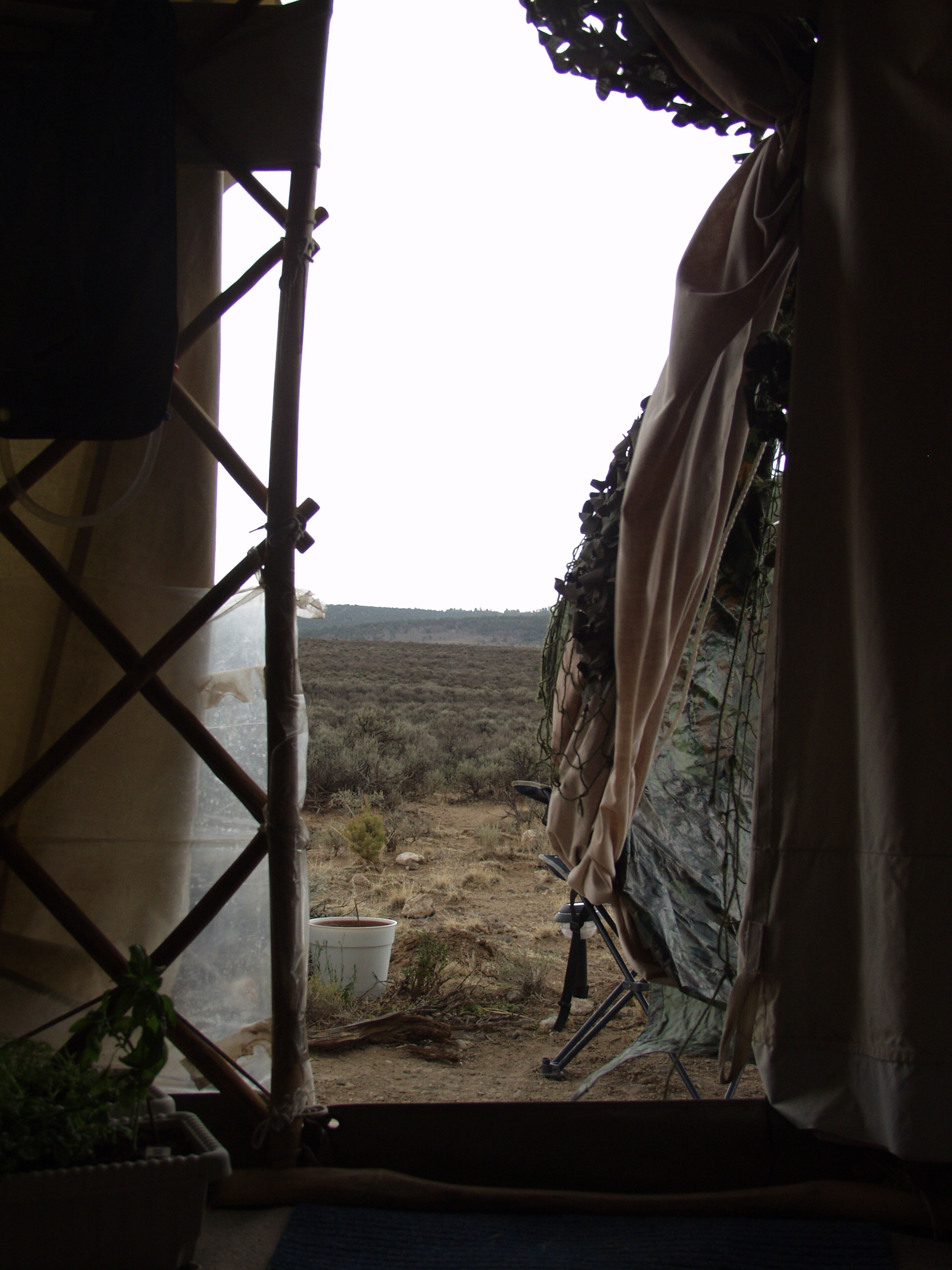
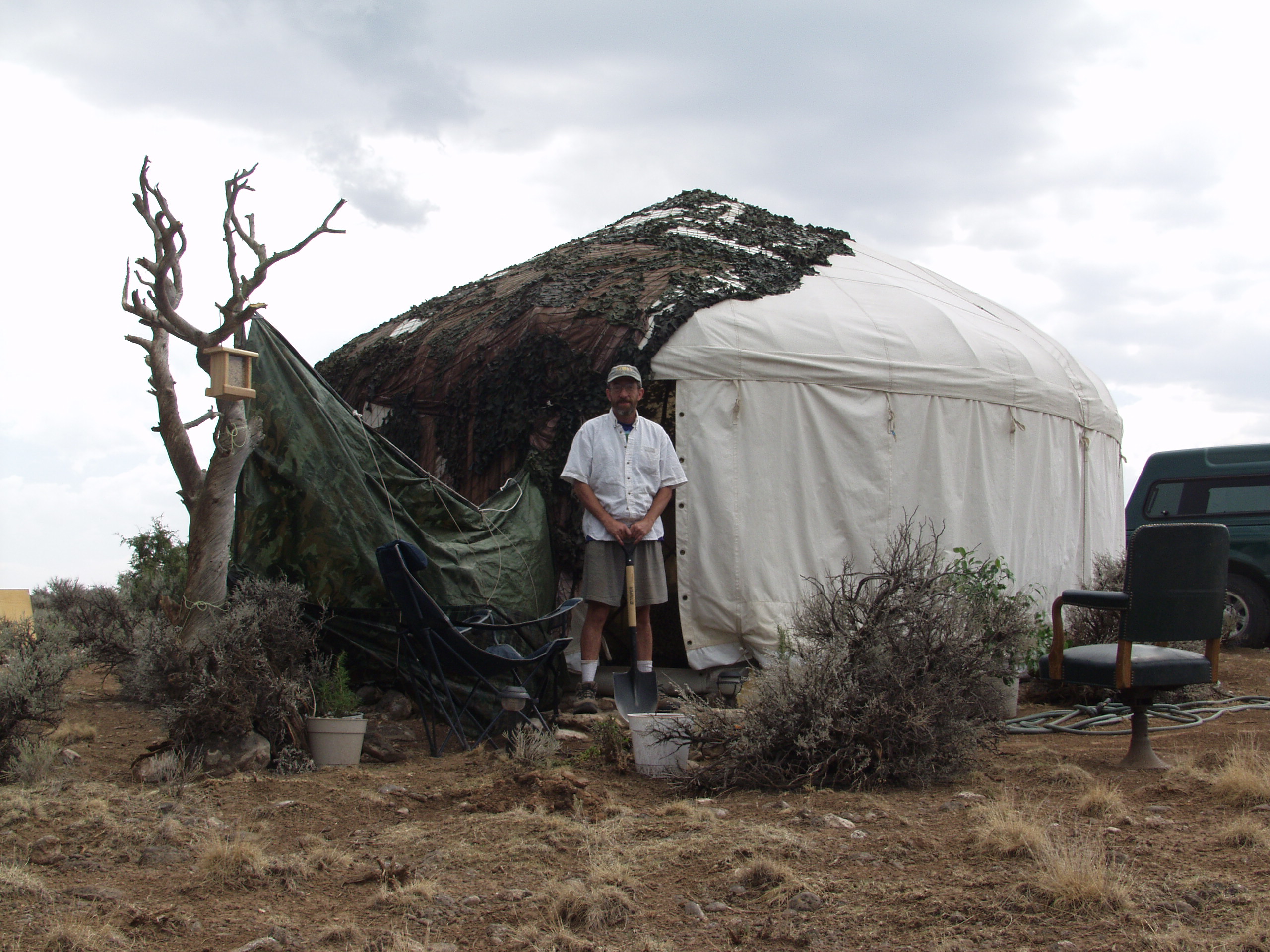 A rented yurt provided a more substantial living space while we worked on the other one. Yurts are used by nomadic Mongolians and bear a resemblance to a circus tent, except that the roof is domed instead of conical. They have scissor-fence wall construction eliminating the need for stakedown ropes and providing surprisingly sturdy protection from the wind and most larger animal intruders. (mice and rattlesnakes are another matter) This yurt was 18 feet in diameter and stood about 12 feet high at the center. The covering was bright white canvas which I covered with some camouflage netting to reduce the “roadside attraction” quality that the unusual tent, the fluttering bale cube, and the 7′ tall domed black water tank created in the otherwise seamless sagebrush expanse. Uninvited interest from passersby is inadvisable until you can lock the door, …or even have a door.
 After Ken had to leave, my three cousins, Monroe, Sandy, and young Zachary, drove out from Michigan and we spent many more sweaty days using the bales to create a pouring form for the foundation of the main house, staking them into the ground with lengths of rebar. The monsoons were just beginning which served to cool things down and shorten the work days.
Before long, everyone had to go and I continued to work getting the form ready. The money was running low so I got some temporary work painting houses for a local contractor. That tied up my days, leaving less and less time or energy to work on the house. And I was still paying rent on my apartment in town.
I still wasn’t quite ready to pour the concrete when the money ran out and winter was approaching. Neither the yurt nor the bathhouse were airtight or insulated so practical wisdom countermanded ego and I sought out-of-town work. I figured that I’d risk some bale deterioration and wait until spring to pour the foundation.
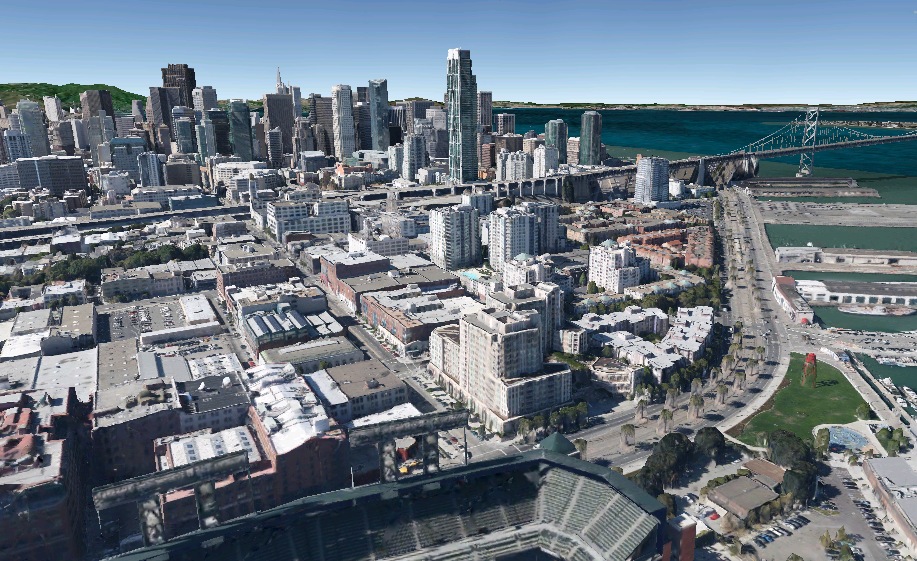 Ken from Seattle had gotten a temporary job offer doing carpentry and general handyman work in a new condo project in San Francisco and needed some backup so I loaded the dog and some tools into the Jeep and hurried to the Bay Area. The job included interim lodging in one of the unoccupied penthouse units with a spectacular view of the Bay. The place was a new property in the tony redevelopment area of South Beach with resort amenties such as pool, spa, gym, concierge service, valet parking, satellite TV, and DSL Internet service. The Muni train, which gave connection to global transportation, conveniently stopped right in front of the building, but working in the building that I lived in made the morning commute an elevator ride. (an inexpressible treasure to an ex-Angeleno)

My new “home” was pretty much the opposite of where I had intended to be. My land in Taos is at 7000 feet and looks across a dry expanse of undeveloped sagebrush; My condo in the sky in San Francisco sat in a densely populated city overlooking the Bay.
The originally short term job stretched on and by January I figured it was time to check on the homestead and give up my apartment in town in Taos to save money.
While it was nice and sunny and maybe in the fifties in the day, there were a couple of inches of snow on the ground and it was pretty cold at night. We pulled in late in the afternoon and I was relieved to see that there were no tire tracks in the snow in the “road” leading to my place. I was concerned that, being so remote, it could be marauded in our absence. Little did I suspect…
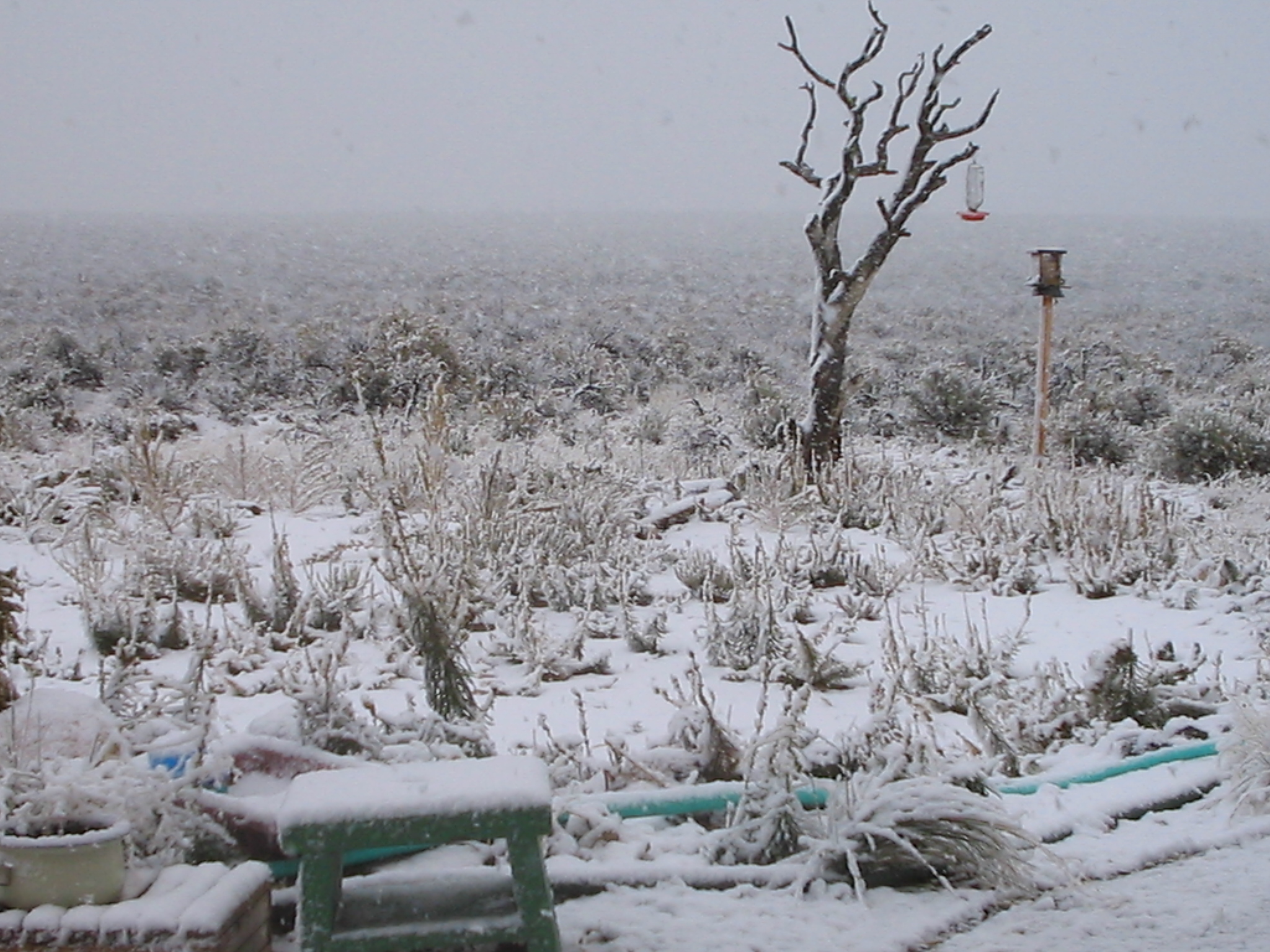 Everything looked so different with the smoothing effect of the snow layer. As I walked to the door of the former bathhouse, now a temporary “cottage”, I noticed straw strewn underfoot. I had been using a couple of bales with a plywood board across them as a sawhorse/worktable. The board was now flat on the ground, resting on a frozen mat of straw. While I puzzled at how the bales could have exploded in such a fashion, I suddenly recognized an abundance of dessicated platter-sized disks of bovine origin littering the area.
…Uh oh.
I looked down the hill to the house site and the bale stack. Yes, the smoothing effect of the snow…. But this was just a little bit too smooth. Picking my way around hefty, straw-enriched treasures and past broken solar-powered garden lights and the nubs of all of last summer’s starter planting, I made my way down to The Scene.
Apparently the imported bales were oat straw, rich in previously unwinnowed oats. What had once been an interesting sculptural work in progress was now a carpet of golden disarray, studded with countless cow cookies.
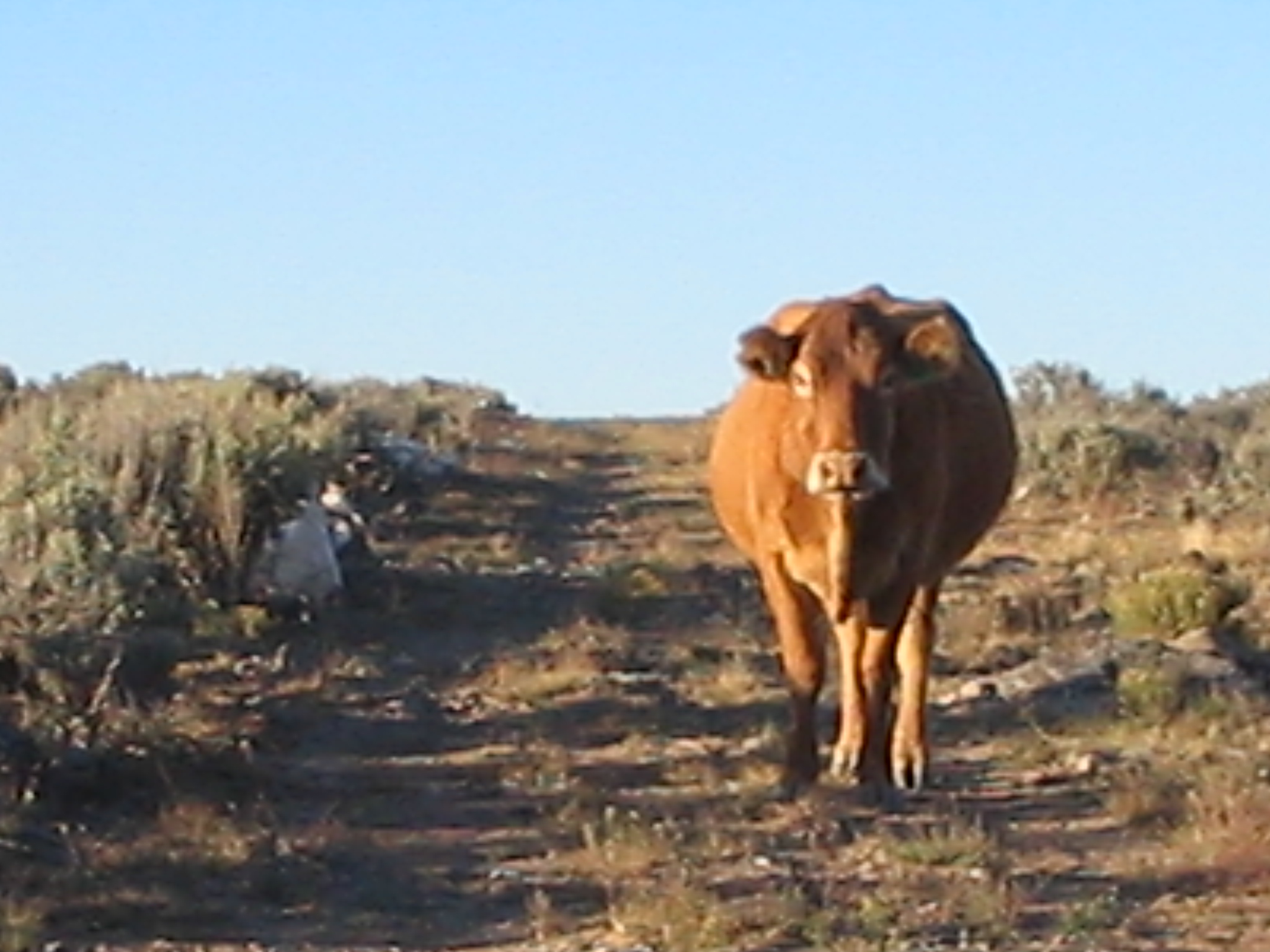 Not a single bale survived.
Aaargh!
What can I say? Open range land, no fences, unattended…who knew?
All I could do was laugh at my own city-boy greenness and the image of this herd of fat cows partying on my land all winter. They only warned me about the Big Bad Wolf. Nobody said anything about cows.
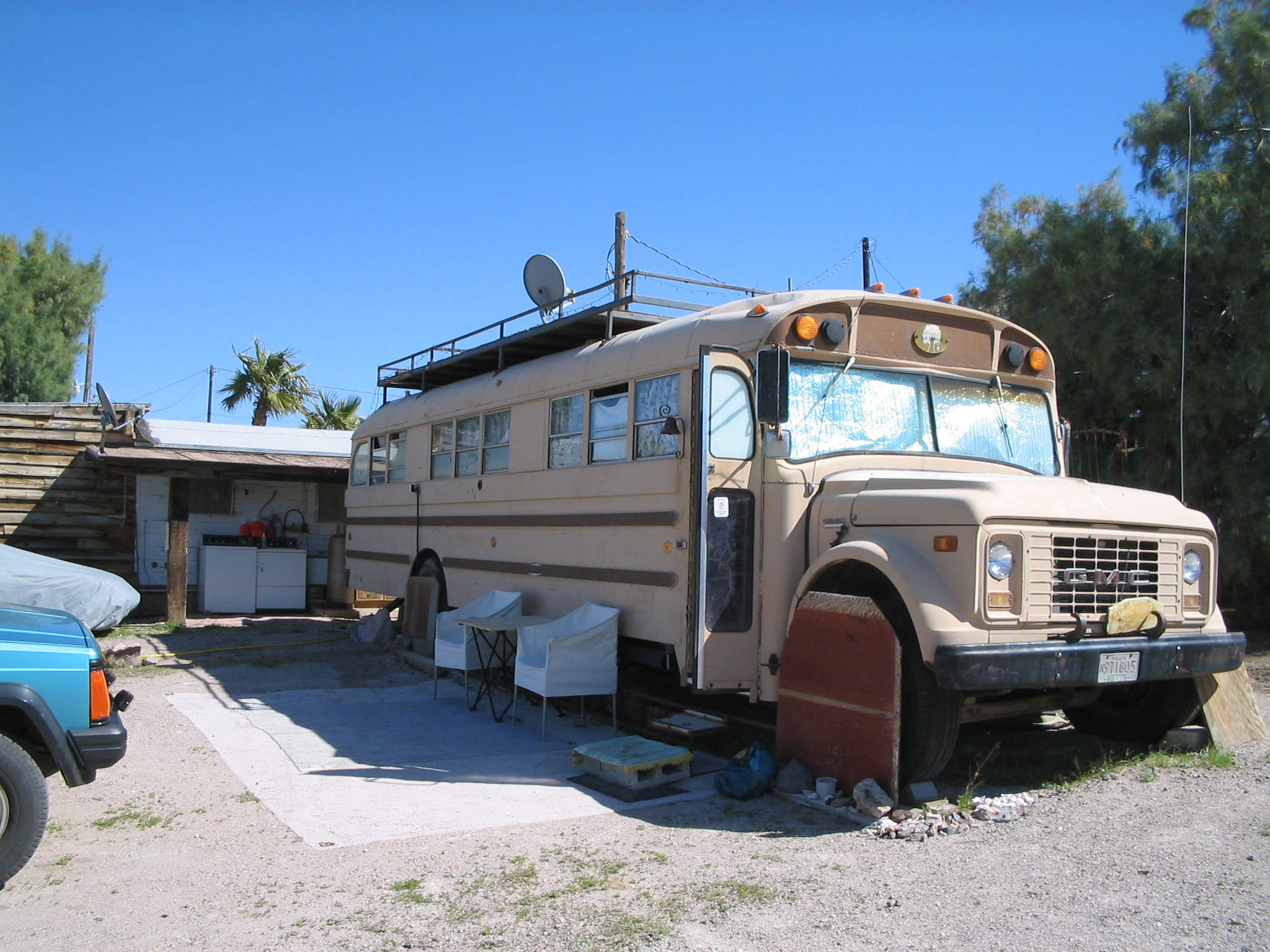 The job in San Francisco ended and I am now wintering in Tecopa, California, near Death Valley, waiting for Taos to thaw. This time I am staying in a Hippie school bus camper conversion with only cold, non-potable running water and electricity for amenities. the toilets and showers are in a bathhouse at the hot springs 3 miles from here, and for gas and groceries, you have to drive the 40 miles to Pahrump in the next state.
But I’m here, so this must be home…for now anyway.
(This story was written in the winter of 2003)
 Hunt Travels