
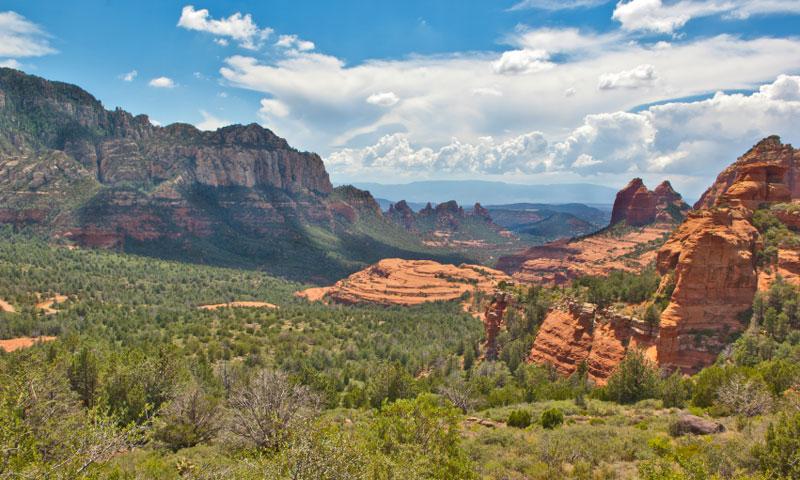
 Snuggled up against the cliffs of the Mogollon Rim in Northern Arizona, Sedona basks in a spectacular region of unparalleled beauty. Colorful cliffs, buttes, and freestanding pinnacles adorn the northern end of Verde Valley, and Oak Creek meanders through towering monuments of red, layered sandstone which sparkle slightly with tiny embedded crystals.
  The arid, high desert valley (el. 5500 feet) sits in the shadow of the San Francisco Peaks on the Mogollon Plateau which boasts the largest ponderosa pine forest in the world and benefits from the creeks and aquifers supplied by the mountain snows.
So lush and hospitable is the region that it has seen human habitation since Clovis Man paleo-Indian hunters and gatherers lived there as early as 11,500 BC. Several different indigenous tribes have lived there over the centuries, most recently Yavapai and Apache, until 1876 when they were forcibly removed and relocated to the San Carlos Reservation, with the first white settlers arriving the same year to plant apples and peaches in Oak Creek Canyon. More settlers, ranchers and farmers mostly, came and by 1902 there were 55 people living in the area and the town was founded, named for Sedona Schnebly, the wife of the first postmaster. 
An authentic old west settlement off the beaten path, it remained an obscure geological gem until Hollywood began using Sedona in 1923 as a film location, (ultimately making more than 60 films there) the rugged terrain often standing in for Texas, California, Nevada and other places, but still the little town grew slowly. By the mid-fifties, the first phone book listed only 155 people, and many areas didn’t get electricity until the sixties.
But by the time I moved to Flagstaff in 1990, the permanent residents had grown to nearly 8000, and the town was a bustling tourist destination. Not only a scenic destination, it became a popular place for retirees and artists. Then in 1987, Jose Arguellas organized a Harmonic Convergence event and the town increasingly became a mecca for New Age seekers of spiritual experiences, some authentic, some faddist, which gave rise to a thriving offering of events, bookstores and coffeehouses.
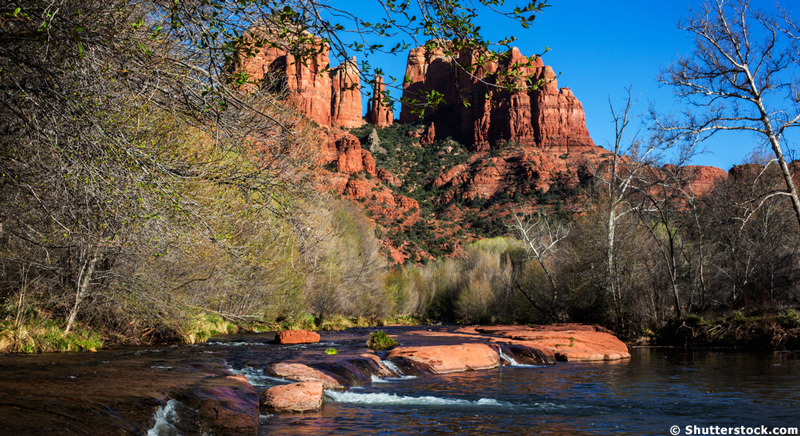 One reason the area drew so many curious seekers was the increasingly popular contention that Sedona was host to several energy vortexes, places where the global geo-energy grid had nodes of palpable energy. The ones closer to town such as Airport Mesa and Bell Rock were popular tourist destinations, evidenced by parked cars, tour buses and the Pepto-Bismol presence of the popular Pink Jeep tours. Others, such as Cathedral Rock, were more remote, requiring some hiking, and were thus spared some of the trampling.
While Sedona is comparable in elevation to “the mile high city”, its arid, southern location and exposure makes it milder with infrequent, transient snow. Flagstaff, where I was living, however, is at 7000 feet and experiences lots of snow and cold gray weather in the winter. I found the mere thirty mile drive down scenic Oak Creek Canyon would drop me down out of the clouds and into warm sunshine and much warmer temperatures so it became my get-away spot that winter.
Boynton Canyon called to me, not only for its purported vortex, but its raw beauty. Streams flowing from Bear Mountain carved through the striated red sandstone, the remains of an uplifted ancient seabed, forming an exquisite sheltered habitat. The floor of the canyon is lush green supporting abundant wildlife, the sheltering red cliffs rising sharply to frame the brilliant blue sky.
 Going west on the narrow road to the canyon from town and past the little ranches and new developments, the road enters BLM land and the farms give way to piñon and cedar trees abruptly ending at a gatehouse to the entrance of an exclusive resort called “Enchantment”, which blocks the entire mouth of the canyon.
 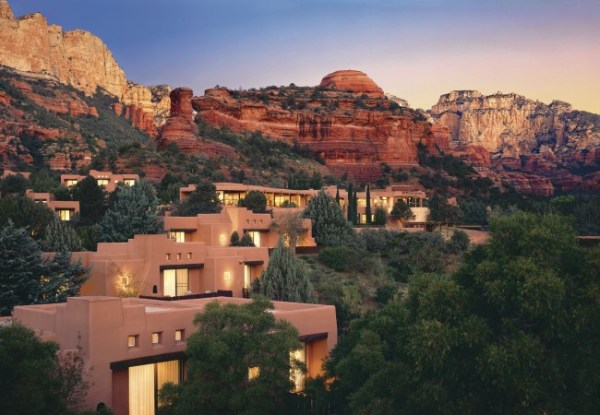 While it has been done quite tastefully and its sandstone stucco buildings merge nicely with the red cliffs, I feel it is an obscene, arrogant intrusion to the primeval monument, particularly since it selfishly blocks access to public land, sacred to the indigenous people. There is an undeveloped dirt parking area shoved off to the side for hikers and an unmarked trailhead leading up the side of the steep canyon to circumvent the exclusive gated community.
 I set out to explore the canyon on my first visit armed only with a crude, hand drawn map in a brochure from one of the bookstores. It showed that there were a few Indian ruins on the north side of the canyon, but the map was hopelessly vague.
My first goal was to find the vortex, which is marked by a freestanding pinnacle not far from the parking area and was easy to find. I felt nothing in particular though it offers a panoramic view, and proceeded to explore up the canyon.  The trail circumvents the resort high up on the canyon wall affording a good view of the village of simple stuccoed cubes and domes poking up through the greenery reminding me of classic Mediterranean seaside villages or perhaps an artist’s version of Atlantis.
A short distance up the trail I approached another hiker coming down. She was scowling and seemed to be hot and footsore as she scuffled down the path toward me. She wore a western style blouse made of some shiny material, slacks, and wholly impractical pink leather cowgirl boots with fringe around the top. She wore no hat and shaded her eyes with her arm as she approached me.
“Hey, do you know where the Indian ruins are?” she almost demanded in a blunt New Jersey accent. She was acting as though someone had deceived her and it was somehow my fault.
“I know there are supposed to be a couple of them here but this is my first time, so I don’t know where.” I replied, immediately rebuffed and not feeling very helpful as a result.
“Well, I GIVE UP! I’ve been hunting long enough. They should mark these things better!” She declared and stalked down the trail, stumbling now and then in those silly boots.
Who’s “they”, I wondered.
Farther up the trail the canyon floor rises to meet the trail which then follows the stream bed until the canyon splits into two tributaries. I pulled out the brochure to see if I could figure out where the ruins were but all it indicated was that they were after the resort, on the right. 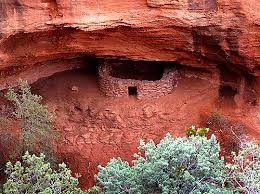 So I just looked at the canyon walls. There was an obvious alcove at the base of the cliff and so I pushed through some weeds and easily found a well worn trail leading to some cliff dwellings, not that far from where I had run into the city girl who apparently didn’t have the sense to look up from the trail or consider where to look for cliff dwellings.
I continued up the canyon until it split off and then climbed up to a high point to get my bearings. From my vantage point, I could see another alcove that seemed a likely place for a dwelling and made my way toward it. This one was much higher up from the canyon floor, almost to the top of the mesa and had no obvious trail to it, given the spring growth, so I bushwhacked for awhile until I found the old neglected trail and made my way up the cliff.
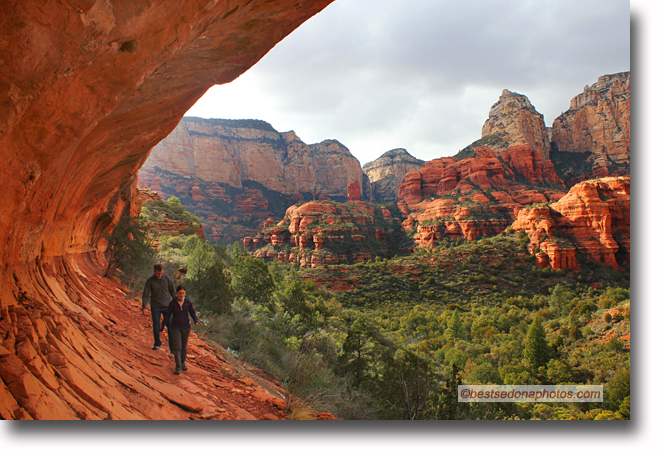 There was a particular stretch of the trail that traversed a broad sandstone shelf that was sheltered by an overhang which seemed familiar, reminding me of similar structures I had seen in the Dordogne River Valley in France where the Cro-Magnon man’s caves are found.
A little farther on were the cliff dwellings, mercifully somewhat less trampled by pink cowgirl boots owing to its remote location.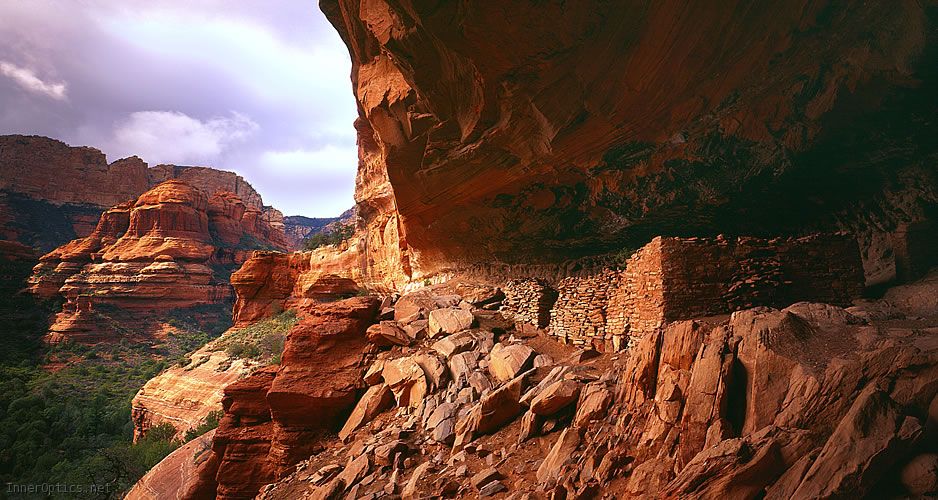
 The view from the site is breathtaking, encompassing most of the lush forested canyon and Bear Mountain beyond.
I felt casually compelled to climb up behind the ruins to a high saddle that offered an unencumbered view of the area. It just felt right to go up there.

I sat down on the sandstone and just took in the panoramic expanse, releasing to the wonder. As I sat in timeless awe, the scene subtly shifted, starting almost as an overlay of images but culminating in the scene from a primeval past. It was the same canyon, same rocks and formations, but it was much greener both in the canyon and on the tops of the mesas and Bear Mountain was covered in snow. The canyon was alive with birds and other wildlife as I gazed at my peaceful realm in satisfaction. A chill wind from my left caused me to snuggle in to my buckskins as I watched a hawk circle over the forest below.
Wait! What?! Buckskins?!
 The scene shifted back to the present abruptly. Nothing moved. It was the same canyon, but today, not then. I am convinced that it was not just imagination, but a real, perhaps shared experience. How many indigenous folks over the thousands of years have sat in that very spot and taken in the same scene? Whether the moment was “imprinted” in the rock or I was sharing a timeless rift to another time, or maybe I even WAS that person in buckskins in a previous life, remembering that day. Whatever it was, it was very real to me and I have held a special reverence for the place ever since.
A short time after that I moved away from Flagstaff and Sedona, and haven’t been back since. But Boynton Canyon is a timeless treasure and I hope to return someday. I’m sure it will endure long after the people are gone and the dust from pink cowgirl boots has settled.
 Hunt Travels